

The rational optimist’s guide to using AI
The expert doctor, coder and teacher in your pocket

I’ve never gotten more emails in one day (over 500!) than when I asked ROS members:
Do you want to learn how to use AI to enhance your life?
So in this special edition of the Rational Optimist Diary, I’ll show you how I use AI to get more done in less time than was ever possible before.
When ChatGPT first debuted, I was where you might be now. AI was more frustrating than helpful. Now, after thousands of hours of trial and error, I can’t imagine working without it.
Imagine having a brilliant personal assistant who never sleeps, builds any website or app you could imagine, and creates personalized lessons for your kids.
That’s just a taste of what AI can do for you today.
There are many “AIs,” each with their own strengths. Last year, OpenAI o3 and Google’s Gemini 2.5 were my chatbots of choice. Now I prefer Claude and use it at least 50 times a day. The monthly subscription is the best money I spend.
Pro tip: skip the free versions. For around $20 a month you can access premium AI models that are dramatically more capable. And better intelligence is only getting cheaper. Three years ago it cost $37.50 to generate a million AI “tokens,” the units that an AI model thinks in. Today the same level of intelligence costs 14 cents. That’s a 99.6% price collapse.
Instead of asking “How do I use AI?” think about what you want to achieve.
Learning Spanish? AI is your patient tutor, available 24/7 for conversation practice. No more $500 Rosetta Stone programs or mediocre phone apps.
Building a business plan? AI is like having a Harvard MBA on speed dial. Need to teach your kid geometry? It’ll create custom practice problems that adjust to their level, complete with step-by-step explanations.
AI is unlike all other technologies in that it’s accessible, cheap, and easy to use for everyone. Usually a new technology is clunky and hard to figure out. Think MS-DOS in the early 80s. We had to wait 10 years until the graphical interface of Windows made computers usable for everyone.
AI is easy to use for anyone right now. You can ask a chatbot how to use it, and it will tell you.
Forget needing 10,000 hours to master a skill. You can get surprisingly good at AI in a few hours.
It’s 7 am. My desk is buried under hundreds of pages of notes about AI, investing, and breakthrough tech.
I love this stuff. I’d happily spend weeks diving deep into these innovation rabbit holes. But there’s a problem.
All these fascinating notes need to become something useful for you, our readers. And that’s when the fear hits. The blank page stares back and my brain is frozen, wondering how to connect these ideas.
This was my every-morning battle. Then I hired the perfect writing partner: AI.
I dump all my research into Claude. My “prompt” is simple: “Using these notes, write an essay on [topic].”
It spits out a terrible first draft in seconds. Yes, terrible. But it conquers the blank page and gets my creative juices flowing. It’s like having a brainstorming buddy who’s always ready to riff on ideas.
I end up throwing away 99% of what AI writes. What matters is AI gets you unstuck and shows you angles you might have missed entirely.
AI then becomes my ruthless editor. Need simpler language? More concrete examples? All you have to do is ask. Get creative: “Explain this like Warren Buffett would.”
AI’s real superpower is speed and instant feedback. Instead of wrestling with a stubborn paragraph for an hour, I can ask for 10 different ways to explain the same idea in minutes.
Pro tip: Give AI context. The more background you provide, the better your results. Treat AI like a new team member. The more it knows, the more helpful it’ll be.
Getting up to speed on a new topic used to mean days of reading, hoping you didn’t miss something crucial.
Those days are over.
Before digging into a topic, I’ll ask AI to serve up the 10 most important articles ever written on it. No more wandering through Google hoping to strike gold.
AI is a shockingly good research filter. Instead of drowning in dense academic papers, I have Claude analyze them and pull out the key insights.
The trick is being specific: “I’m trying to understand why supersonic jets couldn’t make money. What are the three strongest arguments in these papers?” Without clear direction, AI misses the mark.
Want to fast-track your learning? Try AI role play. “You’re an experienced quantum computing researcher. You’ve just hired a junior researcher. What are the five most important things they need to understand about this subject and why?”
My friend and economist Tyler Cowen gave me a simple but powerful tip…
Just ask AI more questions.
Treat AI like your intellectual sparring partner. It’s not Google. Don’t just ask for facts. The best insights often come from the back-and-forth.
I was recently read about Lockheed Martin’s Skunkworks in Byrne Hobart’s excellent book Boom. I wondered about similar rapid innovation projects. One quick question to AI, and suddenly I had fascinating parallels from history.
This is a revolution in learning. Everything you read is now a conversation. I bet within two years, you’ll be able to highlight any passage on your Kindle and get AI commentary instantly.
AI isn’t perfect, but it does 80% of the research grunt work in 1% of the time. You now have a team of tireless research assistants at your fingertips. Learn to use them.
Two simple AI tricks that save me hours each week
1. Taming YouTube. Found an interesting hour-long talk but don’t have the time to watch it? I generate the video’s transcript, feed it to AI, and ask it to pull out the five key points. No more skipping valuable content because I’m short on time.
2. Transcribing data. I needed data from some graphs in the book “100 to 1 in the Stock Market.” Instead of spending hours squinting and typing numbers, I asked AI to convert the image into usable data. What used to be mind-numbing transcription work now takes seconds.
This is just scratching the surface of how AI fits into my daily routine. Think of it as an incredibly versatile assistant that can guide you through almost anything.
Ask yourself: What routine work makes you less valuable? What tasks serve no real purpose and numb your brain? That’s your AI opportunity list right there.
The goal isn’t to replace thinking. AI gives you more time for it.
My advice: Just start. Ask your chatbot of choice to explain something you’ve been curious about. If you’re not sure what to ask, tell AI about yourself, your work, your interests, and let it suggest ways it can help.
The clearer your prompt, the more useful the response you’ll get.
AI models are like a flashlight in a dark warehouse. How you phrase your question is like aiming that beam. Sweep it too broadly and you’ll just get a dim view of everything. Focus it precisely and you’ll illuminate exactly what you need.
Pro tip: Think of AI as a brilliant but literal-minded employee. You wouldn’t tell a new hire “Make this better.” You’d explain specifically what needs improvement. Instead of “help me write an email,” try “write a professional email to reschedule a client meeting, emphasizing how much we value their time.”
Let AI handle the grunt work so you can focus on what we humans do best: spotting unexpected patterns, developing fresh insights, and solving thorny problems in creative ways.
“Dad, how do airplanes fly?”
You know that moment when your child asks a fascinating question, and you fumble through an explanation.
That’s where my journey with AI education began. It’s transformed how I teach my daughter.
Instead of muttering something vague, I asked Claude to create an interactive game showing how airplanes fly. Within seconds, it spat out a simple but engaging simulation. Soon we were playing with a model where my daughter would change wing angles and air speed, watching in real time as her “airplane” soared or dipped.
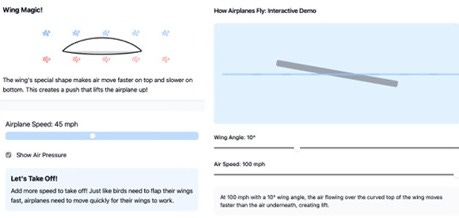
AI transforms how kids learn. As parents (and grandparents), it’s our duty to know this stuff.
Remember in The Matrix where Neo instantly “downloads” kung fu into his brain?
That’s basically possible with coding now.
When Apple debuted the App Store, it sparked a gold rush and created billion-dollar companies like Instagram and Uber, along with tens of thousands of high-paying coding jobs.
But there was always a velvet rope: You needed to speak the language of computers, aka code. Not anymore.
Now you can create software by simply describing what you want in plain English. It’s like having a world-class programmer on speed dial, ready to turn your ideas into reality.
Yes, AI is already world-class at coding. In 2025 the founder of AI coding assistant Devin (a multiple-time world coding champion himself) predicted AI will be the world’s best programmer within two years.
A year later, and Devin is writing 4X as much code for its parent company, Cognition. AI’s productivity gains have become exponential.
AI has evolved to work for 16 hours on end, and the length of tasks it can do is doubling every four months. By the end of this year we’ll have AI that can finish 80+ hour tasks while you sleep.
Claude can write code, search the web, check results, and correct mistakes… until the job is done.
You describe the goal. AI figures out the steps.
I fed Claude six months of bank statements and raw transaction data. It found savings that more than covered my subscription fee.
Then it built me an email assistant that chewed through 5,000 messages. It looked at which emails I actually open and which ones I’ve ignored for months. Within minutes it flagged 82 subscriptions to cut.
It also created a live dashboard that summarizes my emails by must-read, should-read or skip. Instead of drowning I now have a live briefing that feels like a curated newspaper written just for me. This saves me three to four hours a day.
X (Twitter) was the real time-killer. It’s both the single best source of information on the planet and a landfill. The problem is digging through mountains of noise to find the diamonds.
I had Claude Code build me a bot. I gave the agent access to my account and told it to send me a daily summary of the best posts from the people I follow. It lets me spend more time with my kids and less time staring at a screen.
Three projects. Zero code. And my life instantly ran better.
Then I swung for the fences.
I’d wanted to build the Rational Optimist Database for years. Imagine an interactive rolodex of over 900 frontier tech companies we’ve covered at ROS, complete with funding round information and our notes.
I told my new digital intern what I wanted in plain English. Claude Code built it in a weekend. I never had to write a single line of code.
If you’re a Patron to Rational Optimist Society, you have complimentary access to the ROS database, which is growing and evolving as we get to know more companies and founders.
If you’re not yet a Patron, you can go here to become one. We appreciate the support!
The question isn’t “Can you code?” but “What do you want to build?”
The next Uber or Instagram could come from a teacher with a vision to fix education or a teenager with a wild idea and a laptop.
The only thing that matters now is whether you can see the problem clearly enough to describe it.
Why not you, Rational Optimist?
Pro tip: Think of a simple task you’d like to automate, maybe analyzing your monthly expenses. Describe it to AI in plain English and watch your idea come to life. Then scale up. Challenge yourself to keep building bigger.
You have an expert doctor in your pocket.
OpenAI’s o1 AI model is now diagnosing patients more accurately than human physicians. The AI had no extra information. Just better pattern recognition.
In the near future AI will give you a “second opinion” on every medical scan and doctor’s decision. Hello, AI early warning system for your health.
AI won’t replace human doctors. It will make their expertise more accessible to everyone. When I get blood tests or scan results now, I ask AI to explain them in plain English. Then I get follow-up questions to ask my doctor.
I tracked my sleep, recovery, and strain (via a Whoop band) for about six months. I copied my personal data into an Excel file, uploaded it to Claude, and asked it what’s really going on with my body.
In minutes, it created a detailed analysis with all kinds of insights like “don’t work out within two hours of bed” and “eat dinner earlier.” I even had it code a dashboard measuring my sleep patterns since our third child was born.
You can see my son George sank me deep into “sleep debt!”
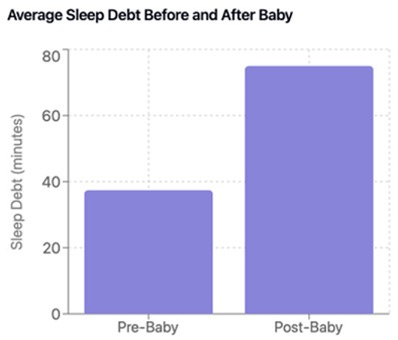
Then I went deeper. I combined my Whoop data with my raw genetic data from 23andMe.
It told me I carry the APOE ε4 variant which increases my risk of Alzheimer’s by 2X to 3X. The good news? Claude recommended aerobic exercise as the ultimate shield for this specific gene. It also suggested a hard cap on my diet: saturated fat must stay under 15g a day to protect my brain.
I used to think melatonin was a safe sleep aid. But because of my MTNR1B variants, taking melatonin hurts my ability to process glucose. I was spiking my blood sugar while trying to sleep!
Obviously, AI shouldn’t replace doctors. But when my son woke up at 5 am covered in angry red blotches, I snapped a photo and asked ChatGPT instead of rushing to the ER. In seconds it told us he likely had a viral infection, nothing serious. We asked for warning signs to watch for, and the anxiety vanished.
You’d be silly not to at least consult this free expert doctor in your pocket. It’s your first line of defense.
Pro tip: Gather your test results, medications, family history and give it to your favorite AI agent. Ask it to summarize your health and tell you what to watch. Then ask: “What should I double-check with my doctor?”
AI can already outdiagnose doctors, build websites in minutes, and tell you what your genes mean for your brain health. The more I use AI, the more I keep thinking…
Our kids will grow up thinking all this is “normal.”
Will they be ready for what comes next?
I’m teaching my kids the “barbell” strategy. On one end of the barbell: Become an AI hyper user.
Adopt every new tool. Learn to build with AI. Use AI until you hit its limits. The people who do this will have capabilities that would have seemed superhuman five years ago.
On the other side: Be more human.
Double down on everything AI can’t replicate. Tell stories. Make someone laugh. Build trust with a handshake. Learn to look people in the eye and inspire them.
When AI can produce competent work on demand, human connection becomes the scarcest resource.
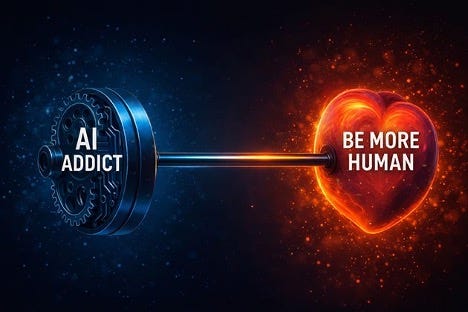
The worst place to be is in the middle. Generic thinking, writing and work are now worthless. AI already does that better than any of us. And it’s getting better every month.
This is why I believe AI will fuel the biggest small business boom in history. The velvet rope that kept people out of tech, medicine, finance and engineering is gone.
We’re entering an era of “extreme leverage” where one or two smart people with AI assistance can build something extraordinary. The next trillion-dollar company might start with someone like you, sitting at home, working with AI to solve a problem you deeply understand.
The AI age doesn’t care about your credentials. It rewards agency, curiosity, and the willingness to try new tools.
That’s the world your kids are growing up into. The only thing that stands between their ideas and a product is the ability to describe the problem.
Teach them to ask deep questions, learn from their mistakes, and find ways to make the world better one project at a time. Build something small… then keep going. Put AI tools in their hands as early as you can.
The future is here. And it’s not about AI replacing human intelligence. These tools amplify our potential.
This is just the beginning of our AI journey together. The Rational Optimist Society will keep you on the cutting edge of what’s possible.
I plan to write a guide to using AI agents next. While chatbots can tell you how to do anything, agents can actually do it for you.
Exciting times.
ROS Membership update: we’re closing in on 30,000 members! Help us recruit more Rational Optimists by clicking the “Like” and “Restack” buttons below.
—Stephen McBride
What about privacy? Input to (most?) AI versions is also used to train the AI. What about personal info leaking into there, and subsequent sale of personal info to data brokers, then to various authoritarian regimes?
Thank you! A great guide to the benefits of AI - very inspiring. It's a marvellous tool we need not fear.