

Quiet skies aren’t free
The price of America’s empty arsenal

In today’s Diary:
A luxury paid in Patriot missiles
High-explosive angel pushers
Wrench vs. warhead
My wife thinks I love war (I hate war)
Wreckage in the conference room
“Costco energy drink?”
Usually founders offer me water before a meeting. Chandler Luzsicza offered me a Kirkland energy drink packed with 200 mg of caffeine.
I’d flown to Austin to meet Chandler, a 24-year-old ex-SpaceX engineer who’s changing how America builds missiles.
He was supposed to be a brain surgeon. Then he discovered premed students spend four years sitting on their hands… while UCLA’s rocket team lets you build things on day one.
By 18, he was interning at SpaceX. He’s a man with a bias for action.
At SpaceX Chandler engineered the thruster that steers the Dragon capsule and brings astronauts home. Then he became lead propulsion engineer on the skyscraper-sized Starship.
Last Fall Chandler started Galadyne because…
“We’re in an American missile crisis.”
According to Pentagon war games America’s stock of critical munitions would last only eight days in a shooting war with China.
In this year’s skirmish with Iran, America fired roughly 10% of its entire national stockpile of Tomahawk cruise missiles in 72 hours. And it will take YEARS to replenish supplies.
As Chandler puts it: “We don’t have enough. We can’t make them fast enough. They’re all super expensive.”
This one’s personal for me.
When people ask what the war was like in Abu Dhabi, where I live, I joke I didn’t know there was one. That’s a luxury paid for by Patriot missiles. During the opening weekend of the war, the UAE spent $1 billion a day knocking Iranian drones and missiles out of the sky.
Why can’t the richest country in history just make more missiles?
Almost every missile America fields runs on a solid rocket motor (SRM). It’s basically a giant firework with the fuel cast into the casing.
“Making a solid rocket motor is like baking a cake,” Chandler told me. You need a factory to bake it. But you also need the ingredients. The key ingredient in every high-performance SRM in America is ammonium perchlorate.
And it’s made in just one building in Utah.
There used to be a second perchlorate plant just outside Las Vegas. But it exploded in 1988, killing two people and injuring another 370.
The material is so dangerous workers who move it around are called “angel pushers.” Chandler said: “Even aside from a covert operation taking out this facility, it could take out itself. And if that happens… America doesn’t make missiles.”
For almost 30 years America’s entire missile arsenal has depended on one plant in Utah.
Chandler’s first idea was to build a second plant. Then he ran into The Blight, aka the tangle of rules and regulations making it nearly impossible to build anything in America. A new explosives plant takes 5 to 10 years just to permit.
Chandler did the most SpaceX thing possible.
Delete the problem.
Instead of spending a decade fighting for a permit to build a second perchlorate plant, Chandler is building missiles that never touch the stuff.
Galadyne’s missiles burn jet fuel and high-grade hydrogen peroxide. The same stuff rebellious teens use to bleach their hair, only way purer. And as the missiles don’t get fueled until it’s “go time,” there are no explosives on the production line.
“You can view these things as empty cars that do not have fuel in them yet,” Chandler says.
Liquid rockets are more efficient. Pound for pound of propellant, they fly farther. They can also throttle, shut down and restart mid-flight.
Did you know the world’s first ballistic missiles were liquid rockets? So too was the rocket that put Americans on the Moon.
America switched to solids because early liquid rockets were a nightmare to handle. The first ICBMs burned liquid oxygen, which boils off in storage, so the missile sat empty and a launch order meant 15 minutes of fueling in a war that gives you 30.
The fix was propellants so reactive they ignite on contact, which could sit in the tanks for years. In 1980 a technician dropped an eight-pound socket. It fell 80 feet and punctured the fuel tank. Hours later the silo exploded, killed an airman, and threw a 9-megaton warhead into a field. Thankfully it didn’t go off.
As Chandler puts it: “Solids were historically chosen because they were easier to operate, not because they were better rockets.”
But over the past two decades SpaceX turned liquid propulsion into a mass-produced, software-controlled process. Today a Falcon 9 launches with a guy pressing one button.
I’m fascinated by a pattern I call “old ideas made new again.” There are trillions of dollars hiding inside ideas from the last century that were right but didn’t pan out because the technology wasn’t ready.
Electric cars outsold gasoline cars in 1900. Gas won anyway because you could refuel in minutes. So EVs lay dormant until Tesla brought them back. Nuclear batteries are running the same loop right now. And so, I learned in Austin, are missiles.
Chandler made it clear we’re still going to need solid rockets. Liquid plumbing weighs too much for small missiles. In fact, Galadyne helps the solid-rocket industry. Every big missile that goes liquid frees up scarce perchlorate for the small ones that need it.
America retired its last liquid missile in 1987. Chandler was born 14 years later. Now he’s running the SpaceX playbook on missiles and becoming…
The Malcolm McLean of missiles.
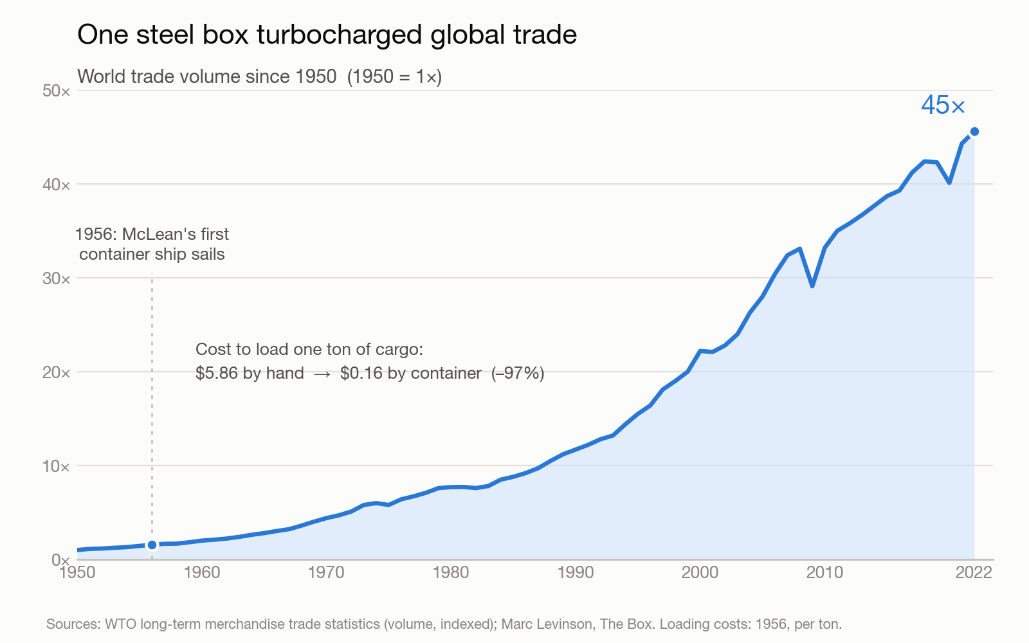
In 1956 trucker Malcolm McLean got tired of watching gangs of longshoremen load ships crate by crate. Ships spent as much time sitting in port as they did sailing.
He wondered: “What if you pack everything into one standard steel box, and move the box?”
The humble shipping container was born. It slashed shipping costs 97% and caused global trade to surge:
Galadyne is doing the same for missiles: standardize the unit and scale up.
Every decision Galadyne makes comes back to a single philosophy: “If we can’t make 10,000 of them, I don’t want to talk about it.”
Almost every hard-tech founder I visit tells me prototypes are easy. Anyone can build a demo.
What separates science projects from real businesses is building 10,000 of the thing.
Galadyne’s first rocket, Striker, is the attack dog. It’s a missile with roughly 1,000 km of range.
Next comes Defender, the interceptor. It knocks incoming ballistic missiles out of the sky.
Chandler’s eyes lit up when telling me about Defender. The curse of missile defense is you’re trying to hit a bullet with a bullet. That’s hard enough even when you use top-of-the-range parts. Now imagine trying to do it with off-the-shelf sensors.
When I asked how Defender will get around it, Chandler described a novel approach, which I’ll keep to myself for now. He calls it the hardest thing he’ll ever build, and he smiled saying that.
Both missiles share the same first stage. Think of it like two car models built on one chassis.
Galadyne’s real breakthrough, and what makes Chandler the “Malcolm McLean of missiles,” is Outpost.
Today most missiles fire from a launch site that’s basically a traveling city. You have launcher trucks, a radar truck, a command-post truck, generator trucks and dozens of soldiers running it. It takes days to set up and is anything but “stealth.”
Outpost is a standard 40-foot shipping container with that entire city built inside.
Chandler walked me to the back of the warehouse to look inside Outpost’s guts. The fueling plumbing goes into the walls and floor. The eight missiles sit flat. Then come go time, hydraulics tilt them upright, the system fuels them, and whoosh!
Outpost’s advantage is its camouflage. It just looks like any normal shipping container, yet it packs eight high-powered liquid rockets inside.
I can’t resist the Dune reference: What’s in the box? “Eight missiles.”

What I love about Galadyne’s factory is there are no offices. The “office” is two rows of desks sitting right on the factory floor. Engineers design rockets within arm’s reach of the hardware they’re building.
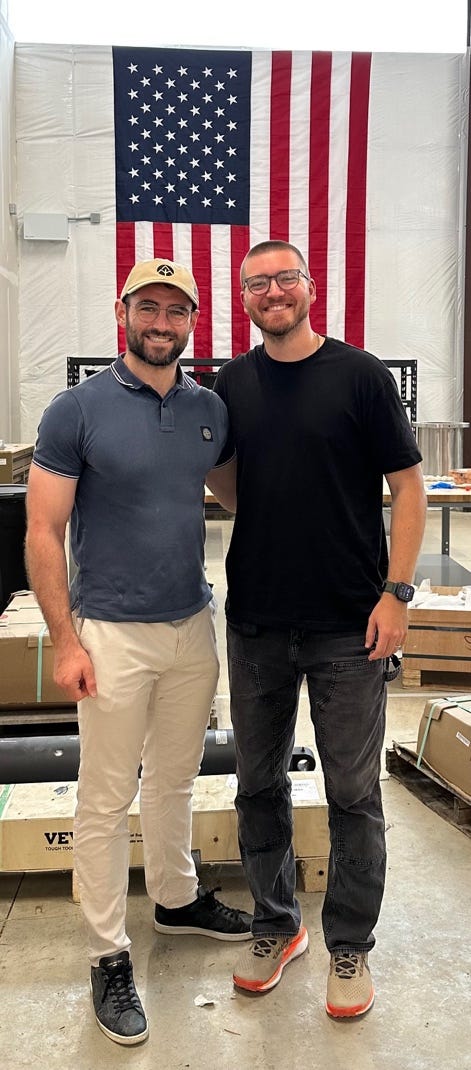
The building is little more than corrugated steel. The walls are nearly bare except for two flags, Texas and the USA, hanging at the back of the warehouse. Here’s Chandler and me:
“Let me show you the first rocket,” Chandler laughed.
It was crumpled like a soda can. After heat treatment the shop lowered the rocket into the cooling bath too quickly. The tank was sealed when it went into the bath. The air inside cooled and shrank, and it crushed the steel inward like a submarine that went too deep. It even snapped the chains holding it!
I asked Chandler what he was going to do with it.
“Turn it into a table for a conference room,” which is pure SpaceX. Starbase is furnished with the wreckage of its own early failures. These companies are moving too fast to be embarrassed.
I visited Galadyne twice this year and you can see these guys are moving at warp speed. First time I visited in April it was Chandler and two other people in a warehouse that felt empty.
When I went back in July the team had grown to 10 people. I saw steel machines running, fuel tanks, rocket bodies and the launch container half-fitted. Galadyne will need a bigger factory very soon.
The whole team wore jeans, t-shirts and sneakers. You’d never guess they’re absolute geniuses. And there wasn’t a single head of grey hair in the building.
Chandler is 24, but my God, he doesn’t act it. He’s already spent five years at SpaceX solving hard problems and talks like a seasoned veteran.
What I liked most was how unfiltered he was. Big-company tours give me an instant ick. Wearing badges and being escorted to conference rooms, yuck. Chandler doesn’t need a minder or a PR person. We chatted for an hour and stood the whole time.
The week after my visit, Galadyne lit its liquid-powered engine for the first time. It’s the first step to transforming how America makes missiles.
When I write about defense tech ROS members often ask:
“Why is a rational optimist championing destruction?”
Even my own wife thinks I like war!
I hate war. I also believe in peace through strength. Wars start when both sides think they can win. The goal is to be so much better than the other guy that he doesn’t even dare start.
America and the West are vulnerable because we don’t have enough ammo. Our enemies know they can bankrupt us by baiting us into firing multimillion-dollar missiles at cheap drones. We need peace through output.
Read the excellent book Freedom’s Forge, and you’ll know we’ve been here before. America won WWII by making an overwhelming number of planes, tanks and munitions.
The first ballistic missile, Germany’s V-2 liquid rocket, was better than anything America had. But it didn’t matter because Germany couldn’t make enough of them.
Fast-forward 80 years and Chandler is making sure the “good guys’” liquid rocket is the one being mass-produced this time.
I regularly get messages from ROS members telling me you forward these letters to your kids and grandkids. Thank you! Our mission is to make the world more rationally optimistic for our kids and to do that, we must show them you can just do things.
When you send this piece add a line at the top: “Find an old idea and make it new again.” Trillion-dollar ideas are hiding in 20th-century failures. I’m convinced many of the best startups over the next decade will marry old ideas with new technology.
The next time you read a scary headline about America’s empty arsenal remember the fix is being built in Austin. “I know a guy solving this problem” is a powerful thing to say.
And keep your eye on the SpaceX mafia. Backing these founders, or just refusing to bet against them, is the most optimistic trade in America.
Pessimists sound smart. Optimists build missile factories.
Hit “like” and “restack” and forward this email to your kids and grandkids and nieces and nephews to bring more young rational optimists into the fold.
— Stephen McBride
Yes. Armed conflict is perhaps the most coldly rational of human endeavors. Want to end it? Then make it clear one side has overwhelming power.
I want that side to be us.
Great post. I am very much an anti-war type, but there’s no denying the importance of a credible deterrence. MAD kept the world at peace for half a century. With the advent of asymmetrical warfare in the form of inexpensive drones, the US definitely needs to step up its game. On that front, having recognized the problem, I am convinced that the young entrepreneurs will solve it and, per your post, are.